All of this crazy talk about inductors and other magnetic circuits recently reminded me of a presentation I did back in college where I had to present some Electrical Engineering concept to a class of 9th graders. I think I did a pretty good job.
Yearly Archives: 2012
Details on the Radial Display
So, last night I posted a video cataloging my creation of a radial spinning disk display (that’s what I’m calling it anyway). It’s not really a new concept or anything, and wasn’t particularly hard to make. That’s why it was the perfect candidate for the video which I think turned out rather well.
I was so excited about finishing the video, that I decided to post it before I had a proper writeup. That’s what this post is for.
Because you can find details on how a radial spinning disk display (or “hard drive clock“) works all over the place, I thought I’d make this sort of a “meta” post and try to catalog not only the project but all of the design decisions (right and wrong) that I made along the way. If you’ve been bored stiff by my super technical posts recently, this should be a welcome departure. I made sure to include tons of photos.
Super Rapid Prototyping a Radial Hard Disk Display Proof of Concept
So, a friend and I were discussing hard drive clocks Tuesday afternoon, and I somehow got it in my head that I had to build something similar that evening.
I had enough supplies lying around to pull it off, and confident that I could, I decided to do a fun little video. Ironically, it took longer for me to edit this video than to make the display. Details on the project here.
The Follies of Driving a Capacitive Load with an H-bridge
Alright, so I had some post-publication weirdness following my last post, and it took me a few days to figure out exactly what was up, but I think I finally have all the details, and I learned a lot in the process.
Continue reading
Dimming an EL panel is harder than it looks
So, this is a project that was nearly a month in the making. I set out to make a sound-reactive EL panel but found that driving EL in such a way is actually kind of difficult. If you’ve been following the blog, I’ve been working on this project in one way or another since my transformers article, and it’s actually the reason I wrote that article.
Again, a disclaimer. There are over 8,000 words in this post that document all of my design decisions on this project. It is not a how-to guide, but if you have some background in EE, I hope that you gain something from it.
Without further ado, let’s get down to business.
Help
Hi, I’m hoping you’d be able to help me on a project I’m doing?
For a concert I’m attending, I really want to have a leather jacket that has LED lights going down both arms, and the spine. I’ve got absolutely no knowledge in wiring or anything to do with circuits, but if simple enough, I can learn.
I’ve found the LED light strips on EBay, the only problem with them, they’re not run by battery. If there is absolutely anyway you could explain how to make the lights battery powered, that a person with minimal knowledge could understand, I would be so greatful!
I would buy something similar to this: <link>
And put it down a jacket like this:
Cheers
A blurry preview of things to come
In Which I Begin to Lose My Mind
In my last post, I attempted to reverse engineer an EL wire power supply to see how it worked. This brought up a few more questions that I decided to investigate, and the following investigation brought me to the brink of insanity and back. I started to doubt the very consistency of space and time as time and time again my measurements seemed to prove what I knew should be impossible.
Seriously, ask any of my friends. I haven’t been able to shut up about this all week. Continue reading
EL Wire is Spanish for…The Wire
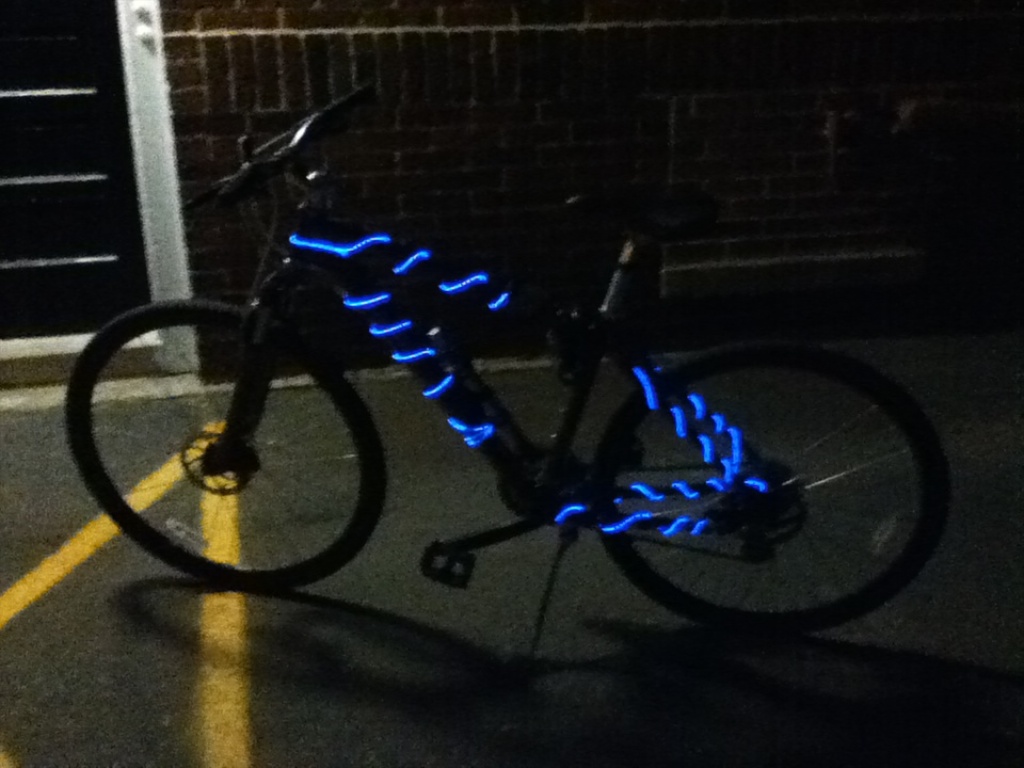
So, after making the shutter shades that made a sensation all over the web, I had a lot of left over electroluminescent wire, and decided to do something with it:
Boom! 100% safer!
QFN24 with no middle pad
Did you ever figure out a solution for your padless QFN chip mentioned here?
https://ch00ftech.com/2010/09/16/flow-and-reflow-are-riding-in-a-boat/#more-467
I may be using the MPU-6150(http://invensense.com/mems/gyro/sixaxis.html) for a project soon and although it has a center pad, it specifically says not to solder it to the PCB. Fairly strange… I’m thinking a little *very* precise hobby knife and tape work might work but was wondering if you had found a solution already.
Also, you’re the guy that made the shot counter. Very cool project, I saw it posted on reddit a while back.